Archive

Archive for the ‘Supervisor Meetings’ Category

PhD Direction Meeting 13 Nov 2008

November 13th, 2008 No comments

Met with Simon and Aaron this morning to talk about the direction of my PhD 🙂

I introduced the city sensing idea that Paddy and I had talked about – and that I had previously sent to Simon to comment on.

I also started by saying that I am interested in the problem of Delay Tolerant Networks.

Firstly, we tried to sketch out the problem to be solved – I could not really describe it, so Aaron suggested that one of the problems is that of infrastructure – i.e. it is very expensive to install and use. For example, is every phone in Dublin was reporting sensor data, it would firstly swamp the network, and secondly be prohibitively expensive.

Simon also suggested that it was a problem of coverage – in areas where there is no infrastructure, how to do you report sensor data?

Aaron and Simon stressed that it was important to relate this problem to the real world by giving real examples – such as figures for infrastructure cost – data usage and network utilisation. But if we cannot get figures for this, we can make estimates based on what we do know.

Aaron mentioned an experiment he did when in Australia with ?(Dan)? which tested bluetooth hand-off times – and found that the handshake time was very long – and too long for passing nodes to exchange data. Simon and Aaron therefore suggested that a low level protocol could be designed, that if we assume it existed – could form the basis from which my contribution works.

This would mean that any system based on this, would have to be simulated, as the protocol itself would not be implemented for real (not by me anyway). Ideally however, I would have a system running on every phone in Dublin from now until when I analyse the data, however, this is not going to happen. But having it run on 10 phones would be nice, on 100 would be difficult but better, on 1000 phones, very very hard but very nice.

However, at this point, my contribution is unclear – so we discussed some ideas:

  • Micro messaging of data, small packets sent until out of range, making it as efficient as possible, some data wont get sent, but some will.
  • Reporting that things are normal, but not sending the data, as it can be derived that if there is nothing abnormal, then we wont send data we just ACK that everything is ok. – I suggested that this may be similar to Erasure coding which xors messages against previous known messages to extract the new message.
  • Perhaps we could utilise a mechanism for piggy-backing data over existing protocols – such as Bluetooth Friendly names, or spoofed MAC addresses, or on ARP requests.

We discussed simulations, and Aaron noted that Brendan has cluster access for processing large amounts of data – and also mentioned OmNet for running simulations.

Aaron mentioned that when they wrote their own simulation, it was deemed a bad idea, because there is no way to evaluate it, so suggested that we should not write out own simulator for anything.

I mentioned that a paper I had read had used information from wireless access points use (CRAWDAD) to simulate a network of people, and mentioned that I had contacted IT services at UCD to see what data they keep about access point use, and whether we can use it. Aaron suggested that I email him and Simon with my request and they will see if they get access to the data.

Simon mentioned Bill Hilliers book – space is the machine – which is worth dipping into when considering how to simulate city environments.

Aaron said that his student ?Dan? had taken a real un-related dataset, and synthesised a relevant data set from it (iSpy search dataset).

Another dataset that is apparently available is live data from traffic lights in Dublin, which shows the position of the lights, the number of cars queueing and is available live onlin.  – I wil email Kevin McCarthy who may know who has information about this.

I suggested that we could get traces of data from second life, which may give a good dataset for simulating the movement of people around a geographic area. This has inherent problems, but might be interesting.

I Suggested that there was (based on a survey paper by Zhensheng Zhang 2006 [1]) a research area for profiling nodes in a network to predict their future movements, which prompted:

Simon gave an example of a system used at Reading university where they tracked people in a building using RFID tags, and found that people generally had very predictable routines.

Simon also mentioned a paper by Sandy Pentland about familiar strangers – the people you come into contact with regularly, that you don’t necessarily know – these people could be used (discretely) to send messages to people they may come into contact with.

Aaron introduced a Clarity Project called Sense in the City, or more specifically GOYA which he thinks I may be able to become involved with, and he suggested that I email Paddy and Barry to say that I would like the slides from the CLARITY away day, and that I would like to find out more information about the project it becomes a reality – but that I shouldn’t spend too much time on finding out about it at the moment.

The project envisages using a network of bicycles which are installed with sensors, that people use to get around the city. He suggested that it is a good idea to have a case study – such as this – which tests my system in the real world with interesting results.

He also mentioned the idea of Healthy Spaces – urban parks where people walk around – may not be obvious on the map – but in return for generating interesting sensor data, we can map out where these places are – and perhaps contribute to the health credits idea (discount on Health insurance).

We identified some next actions:

  • Matt: Document: define the problem, define the motivation
  • Matt: Email paddy + Barry for slides
  • Matt: Email Simon + Aaron about wireless access points log access
  • Matt: Email Kevin about traffic information
City wide environment sensing overview

October 15th, 2008 No comments

city-wide-environmental-sensing-overview

The document I drew up after supervisor meeting – to get a general overview of the idea.

Supervisor Meeting 09 Oct 2008

October 9th, 2008 No comments

Meeting with Paddy – pep talk to make me feel better – Paddy took 3 1/2 years to complete PhD, but changed his subject after tranfer report – and still managed to finish on time – even though I AM NOT brighter than him, I should be ok 😉

OK – lets get going with the city wide environmental sensing!

Need to think about:

What simulators are there? What infrastructure do we need to get it to work?

The underlying hard questions are:

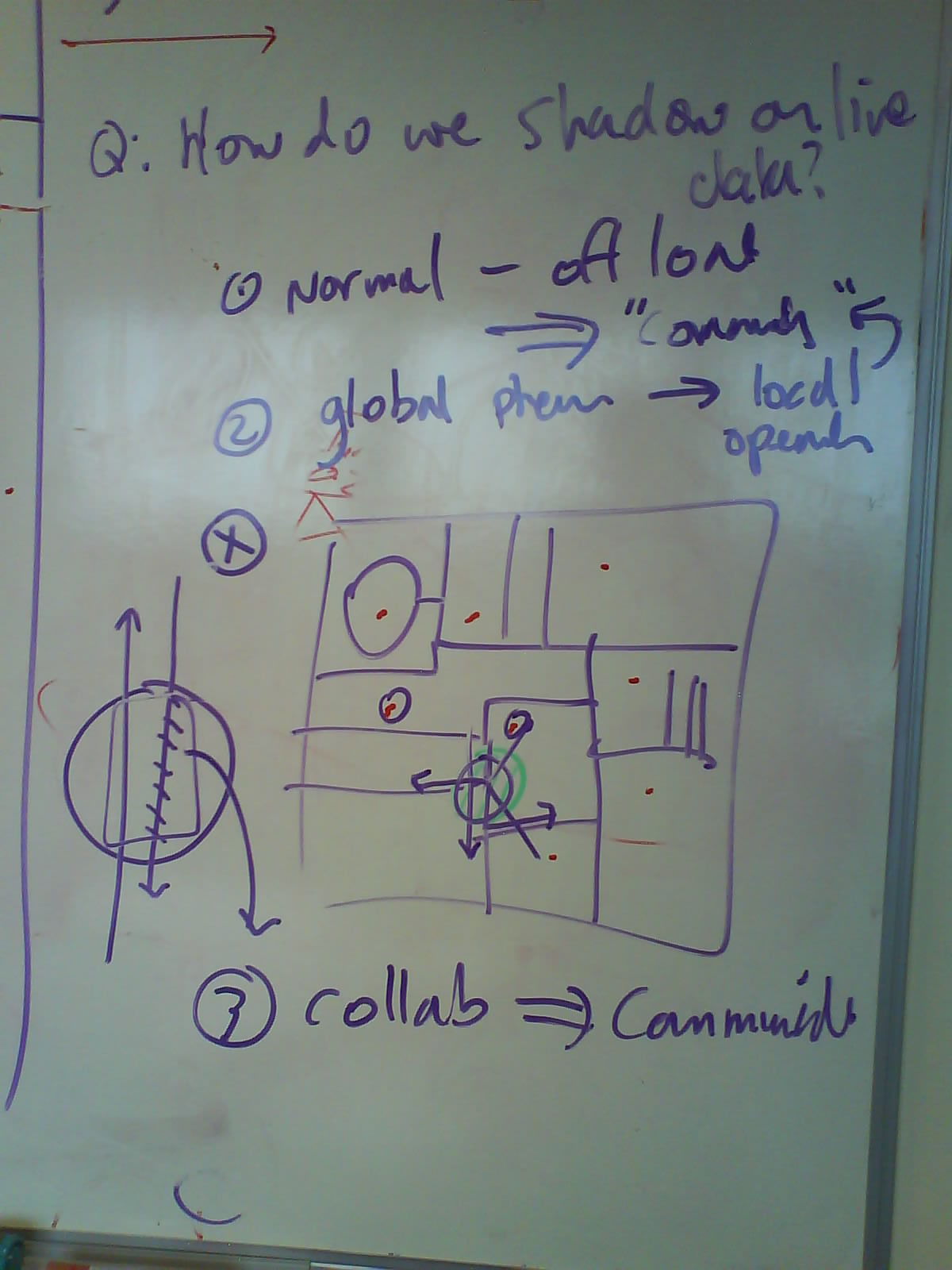
1- Collecting Data

Offloading data in normal operation to fixed nodes or drop off points about the city-

issues

  • Storage
  • Sampling
  • Longevity
  • Power consumption
  • Date/Time  corroboration

The things on the body communicate, perhaps one is doing the monitoring, and others are managing the storage and dissemination of data across local nodes

Managed the local set as a community

2 – Global Control – Global Phenomena drives local operations

If we can assume nodes have a facility to geo-locate themselved, nodes can use or build a map of the area they are in. As the overall control system (?) detects issues or hotspots, it may increase the frequency of sampling in a particular area – this will require mechanisms to cope with this – considering multiple hot spots.

The idea being that some how nodes would be told to make more detections on certain areas – or even based on certain criteria – e.g if CO2 level > x increase freq.?

This then feeds back to the community – perhaps imagined as a  big async. query over the community.

3 – Cute part

When nodes pass through a hot-spot – what happens if they are not going past any other known drop off  node? Communicate with a node passing the other way through?  How to we manage this and what data – dead-reckoning? probability of passing another node?

Do the nodes always promiscuosly send data – or just sometimes?

Nodes Collaborate to communicate a response and are managed as a community or a swarm

We defined some next actions:

1 – Create  1 page vision document – deadline 3-4 days

To describe –

  • Community management
  • Fixed Nodes about an space
  • Group of devices about a person
  • Community of individuals with wearables
  • Granularity of resources (?)
  • How the overall community will work – what will be the infrastructure  – given our resources

2 – Slick the document up, and send it off to out peers in Harvard, to see if it will fit into their project

3 – When bored of writing – consider:

  • How do cities work? where do people go?
  • How do we simulate a city wide sensor network like this
  • Look at existing applications to simulate cities -flame.ac.uk – metropolis.tcd.ie – Steve Collins and Carol Sullivan
  • Look into cheap environmental sensors – bluetooth based – if we can get some which are cheap enough – we can get some and deploy over CASL/CSI/Campus?

4 – Overall Goal is to have a 6 month project – which will support my PhD, to make these new tecniques that we will develop – either as a simulation, real world deployment, or a mixture of both,

  • Will need to research the idea of decision theory
  • Community resource management

5 – Personal Task

  • to find out what research is going on in UCD and Clarity
  • Start with Barry Smith – ask who is doing what work – paddy wants to do wearbles – and wants to know who’s doing what research in the area

6 – Look for places to put position papers into

Finally – we need to keep some pressure on – and have some quick turn-arounds – and I should talk go talk to him if the ideas we discussed dont make sense afterwards.

Supervisor Meeting 02 Oct 2008

October 2nd, 2008 No comments

Met with Paddy and discussed what we need to be on with – we both seem to have been thinking about different things – I seem to have gone down a route of something to do with mobile phones – but it needs to be linked to what we are getting at. I said that I don’t really know what wearable computing really means – as I haven’t seen it in the flesh!

Really need to get into the idea of what infrastructure is needed to make wearable systems work – think of it more as network of wearable sensors.

What issues are there when we are thinking about transferring data amongst nodes – what if instead of being centrally managed – what if they could freely communicate with each other.

Discussed the idea of city wide environmental sensing – a mixture of fixed and mobile nodes which are tagging and recording data – offloading to nodes with big pipes – how does this work – and how do we implement it?

Also need to think about issues such as transient and persistant data – what is kept and what is shared and removed – what is private what is encrypted what is not?

Example application is
citywide environmental monitoring – fixed nodes talk each other and share data,
they also talk to mobile nodes to get data –application to monitor an area.

Nodes about the body can
communicate to other nodes on other bodies, handing off data – gossiping –
every piece of data has timestamp – and is tagged so that that it can be
synchronised at a later date.

Also –  talked about  developing some things that we say is good for
wearable computing – i.e. p2p vs managed nodes then compare previous wearable implementations
to our idea of whats best and see if they succeeded.

Hundreds of shimmers
downstairs in clarity to have a play with.

Speak to Julie doyle
about user study – work out what we are trying to get out and keep it in the back of my head.

Paddy suggested this was a turning point – are we
interested in hard computer science part?  Or more the HCI part?

Overall we really get down to the
basics –

What will be good
about P2P vs Central Node?

What is persistant
what is transient?

Matt Walsh – they have
the OS with low level access to data – what do we need to do to get something up and running?

Supervisor meeting 20 Aug 2008

August 20th, 2008 No comments

Part 1 – Wearables

Assumptions – Paddys Notes

Met with Paddy to talk about Wearable computing Assumptions.

Discussed the short-list that I had come up with: Assumptions about Wearable Computing

Paddy gave his thoughts about what I had come up with – and we came to the following main assumptions that we will look at and question their validity:

  • Communication bandwidth is an issue
    • What data do we really send? – Sensors/Video/Other
    • 3G is quick
  • Wearables are individual
    • Data is private, Infrastructure is community
  • We need to optimize for power
    • What if we don’t – usage patterns
  • Processing power is minimal
    • Not any more – processing power is good – PDA -iPhone etc.
  • One managing node
    • Emergence
    • pure p2p
    • individually addressable(ipv6?)

Tasks:

Matt:

Rethink the systems/paradigms/stuff that I have read/seen/tested and see what would happen if we took out these assumptions.

Suggest that these things are not really true anymore, and that they can be considered to be a myth.

Write up an internal paper/report (3 pages) that suggests this, and  covers the reasons why, and see what people think. – Debunking the Wearable Myth

Part 2 – Basadaeir

I suggested to Paddy that  we should do something with Basadaeir, and that it is one of the missing parts of the construct project, the profiled/static/persistent entity that contributes to the pervasive environment. He agreed that we should develop it, and was planning to require that all new people register with it.

He also suggested a case/research study for it, building collaboration not just through keywords, but also by matching presence of other people at the same time – e.g. when people are often in the same place at the same time, they may be connected somehow.

Tasks:

Matt:

Get the system robust and working – so that people can sign up and start using it –

  • CRUD for profiles
  • Efficient processing of data
  • API for external applications
  • Internalised third part applications (like fbook) – so that others can solicit more information about topics – e.g. research keywords.

Paddy:

Will tell people that this system will be available, and will expect that at some point Matt will have it working – no particular timescale.

Supervisor Meeting 17 July 2008

July 17th, 2008 No comments

Met with paddy this morning to talk about where to go from here.

I’ve been reading around Context, Privacy, Infrastructure, Management etc. in relation to wearable computing. There are a number of texts that mention it, but nothing (so far) that has dealt with it directly.

Paddy suggested reading and using the idea from http://infoblog.stanford.edu/ that you take the main assumptions about an area, list them out, then change one or two of them, and see what happens. (yet to read artical)

Also, paddy suggested to have a think about stream processing.

I should also look at the locations/conferences/groups that are doing these thing – i.e. find papers that are newer, and may not be highly cited.

Suggested conferences to look into:

MobHoc, MobiCom, Middleware, etc

Paddy also mentioned that reading can expand to fill all available time, so don’t let!

Supervisor Meeting 27 June 2008

June 30th, 2008 1 comment

Paddy and I met to discuss the IRCSET Report and my research direction.

Regards the former, the document I wrote was fine, and Paddy will submit a supervisor report separately (as per the IRCSET guidelines).

Regards the latter, I said that I felt that although I had been reading around many areas, and was enthused by attending Pervasive 2008, I did not really have a particular topic that I was readings around. Paddy suggested that allthough I effectively have the freedom (within reason) to research what I wanted, he has some ideas that I could work on.

The topic he suggested was to investigate Wearable Computing/Technology, and to build up my knowledge on the subject by spending the following week doing a breadth-first search of the related literature. We suggested and we agreed that the emphasis could be on the infrastructure and management of wearable technologies within pervasive computing environments. Areas/Issues of interest (some added by me later) being:

power, communications, compliance, privacy, commonalities, categorisation, storage & reporting, processing capacity……

The 1 week project resulting in me finding 3-4 good papers in the field that Paddy and I could use to discuss further research.

Also discussed at the meeting, with Aaron was what to do with the Basadaeir system, we decided that we should meet together (Paddy, Aaron, Matt and Julie) to talk about  where this project could head.

We also briefly talked about Aaron’s Bluetooth idea of encoding communications into Bluetooth name strings, and decided to discuss that at a later date. Aaron will send me his thoughts to date on the project.

Supervisor Meeting 27Feb 2008

February 27th, 2008 No comments

In todays supervisor meeting, we discussed mostly a new project, for submission to Ubicomp 2008 (deadline 4th April) which combines sensormash and CFP into a robust system for matching people to interests and bringing about new possibilities for collaboration by displaying information in an untuitive and informative way.

details are here: Meeting 27Feb2008

17 Oct 2007 Meeting

October 17th, 2007 1 comment

Attached is 17 October Supervisor Meeting minutes, the Main tasks are:

  • Reading – paddy will suggest a thesis (or 2) to read, and also get a good paper from the conference, that can be used to get an idea of style etc.
  • Spk to Tom re shimmers
  • Also speak to lorcan/steve about other sensors we have about the place (MSP’s, gumstix)
  • Matt will speak to Simon D and together with paddy will bounce ideas off him
  • Matt will setup a blog/wiki for paddy to keep a track of whats going on in Matt’s PhDLand….
  • Speak to RAS / Raz about cross layer management – autonomy
Categories: Supervisor Meetings

18 September Meeting

September 18th, 2007 No comments

18 September Meeting

ACM Digital Libratry
Acm.org/dl
IEEE
Search for research title and other keywords – / autonomics/adaptive/reconfigure etc
etc.
Also review papers.
Look into bibdesk
Q’s for paddy
• Student number/ 2nd supr
Simon is 2nd
Modules check:
(Should be doing MSC ones not UG)
Machine learning s2
Dist Systems S2
Natural Comp. S1
Data Mining S1
• Reading
Read about construct and get papers from Steve and Lorcan etc etc.
Paddy will give 2-3 papers, read those then find references etc etc.
*** Read the Abstract, introduction then conclusion to see if paper is worth reading
CREATE a WIKI or similar to keep paddy informed of status/reading/what produced
So he can make sure on the right track, and keep up to date
Observe questions that are being asked, distill them, summarise them
To create a classification Taxonomy to see what has been done and where
there are gaps!
• Goals and timeline:
Learn Construct and contribute to SRG community with mini-project 1 – Month
Create website for SRG members – collab. With joe – 1 month
Lit Review – 3 months
After 2-3 months start a meaty programming project that asks/solves questions in area
of interest,
• Conferences
• Submission Format
After 1 year create transfer report + research plan which will be discussed by panel to
see if to continue
2nd Supr is Simon

Categories: Supervisor Meetings