Archive

Archive for the ‘Supervisor Meetings’ Category

Quick meeting with Paddy 6th May 2010

May 6th, 2010 2 comments

Met with paddy in his office and discussed updates so far.

Paddy wants to see something tangible by next week’s update – i.e. a worked example of how vector clocks will work in terms of location.

Also emphasised that I should not get sidetracked! (of course!)

Suggested storing temporal  information (parallel vector clocks?) – e.g. a from to, so that we can say things like does this time overlap this one, is it contained withing etc. etc.

Also thought about how to define location – the bounding of the location  gives an experimentation thing – change the grid size – whats the computation impact of the size of the grid – and what the relevance e.g. too big and it makes realistic.

Construct vector stamps – 5 separate path across these locations, two or three allow drop messages – run through and pick various vector clocks at various times, and show them. Then start generalising them.

From this we can draw general things about e.g.: decisions made, what information is stored, what we put in vector clocks, what operators we need.

Then run a simulation and see if generalisation works. Then we can see if some things fall down, and come back and change things.

Should stick with ideas about location, not proximity yet.

Using this it is then possible to write this concisely.

Actions:

  • Generate a worked example/scenario
    • show examples of vector clocks at times
    • show the movements over time
  • Don’t get sidetracked!

Supervisor PhD Meeting 14 Apr 2010

April 15th, 2010 2 comments

Had a meeting with Paddy for me to pitch my ideas.

This was the basis of my Pitch_to_Paddy

Mobility is NOT location…. see Simons paper

Discussed my ‘Hypothesis’

  • Human mobility patterns are predictable
  • Human proximity patterns are predictable
  • Knowledge of proximity and location makes opportunistic routing more efficient than proximity alone.
  • Proximity and Mobility can be used independantly to achieve the same efficiency in oppotunistic networking.
  • Mobility or Proximity can be discounted when planning opportunistic networking algorithms.
  • There are low complexity algorithms based on vector clocks that can be used for routing
  • Any given node will only need to communicate with with other nodes that they know (friends), or want to know (friends of friends).
    • Paddy suggested this might be a bit like a DNS tree, which hands off knowledge
    • Also experiments need to establish that a friend or a friends of a friends knowledge is enough to route
    • Might establish that 3 degrees is more than enouhg
    • tradeoff = you can get better efficiency if you give more coverage of the network

Local Metrics

Using vector clocks –

Range – how many hops away – build a knowledge about the network using information in the vector clocks – how do you do that? This is a PhD part.

How do we determine the important nodes? – the Aaron Quigley effect.

Nodes in your ball of radius = sphere of interest = friends, +1 hop = friends of friends, +1 = everyone else.

Dig out reviews on DTN’s – especially patterns  – but paddy thinks that the notion of location and proximity have never been used, but the patterning structures e.g. highly important update nodes.  So i need to look at ways of discovering special nodes. How do they determine that . Location thing seems to be different- find a review.

Mobility as opposed to location – gives your prediction element.

Limit the range of forward projection.

Datasets

Email GW to see if he can get a public dataset. – sign over under NDA?

Email Barry Smith to see if he knows of any datasets we can use. – Vodaphone dataset?

Email Aaron Quigley – he will know if there is any publicly available – his masters student has access to a corporate travel dataset.

Also – see Simons Paper about location.

Look up Intel Placelab dataset

Email knox to see what datasets he might have.

Progression

Paddy not sure where the Vector clocks fit in

Is it a novel implemenation mech. – i.e. am I going to use vector clocks in this thing.

I want to make a prototype. – paddy likes the idea – there are some hard questions – some novelty in there. This parts Understanding how to frame solid hypothesis. reading reviews. building exp structure, breaking out a few bits – vector clocks, heuristics about making decisions, how it all fits together.

Ideas about locations

Not fully formed so need to think a bit more about it

Future

We can turn the VC thing on its head, and make it useful for proximity and location.

I want to build prototype

Need to be careful not to spend too much time comparing to existing things if they are not really related.

Important thing is does it matter where you are when I pass you a message  – as proximity and mobility are the same – do I pass it to you because i know you see that person, or because I know you will be in the same location as that person.

Nodes can predict their own positions – share this information with other nodes – paddy suggested sharing based on the types of people – e.g. friends get detailed info, FOAF get  obfuscated location, others get much broader information.

Requests?

Does a node do calculations about other nodes, or does it ask the other node – can you get this to this person?

A little but like Agent systems?

You might have different approaches depending on who you are dealing with – e.g. message to a friends goes through friends, message to FOAF goes otherwise, everyone else – can you get it to somewhere nearer than me – or somehting…

Then we can say we of course can encrypt this information.

Plan

Paddy felt that vector clocks etc. that are used to encode e.g. double vecotr cocoks location mobility, is a solid piece of work, and if it gets into a good conference, then it is my PhD.

It will need a Order of computaion section with a complexity analysis i.e. is it N^N, Nlog(N), N^2, N^3 – dont go much beyond that  – need to analyse the algorithms at the end. well travelled ground about what the complexity of vector clocks is.

I want to Nail down what these metrics in the system are, then implement CAR using these metrics as well as coming up with my own algorithm.

Need to convince Paddy what algorithms/datasets to compare with, there needs to be a good rationale be behind it.

Need to refine the contributions bit – but this will come with time

Hypotheis section is  good – but must refine and remove negative ones – it should keep the positive ones, and prove one thing true or false – pick the one we think is most likely.

Add another hypothesis that low complexity algorithms based on vecotr clocks (30:24)  can be used.

Dont go down rabbit holes!!! Give Paddy weekly updates – every Friday – nag paddy – if he has not  responded by 10am monday – Paddy will comment back

Tighten up – look at knox Hyp section. – and write a halfpage hypothesis introduction and a one/two line hypothesis at the end.

Aside:

Can we use Barabasi way to generate new dataset – almost reverse engineer their preditions, and try to get a dataset based on it?

e.g. Random graph of streets for dublin, randomly place nodes – simulator and start to make locations as the predictions.

Dig out reviews on DTN’
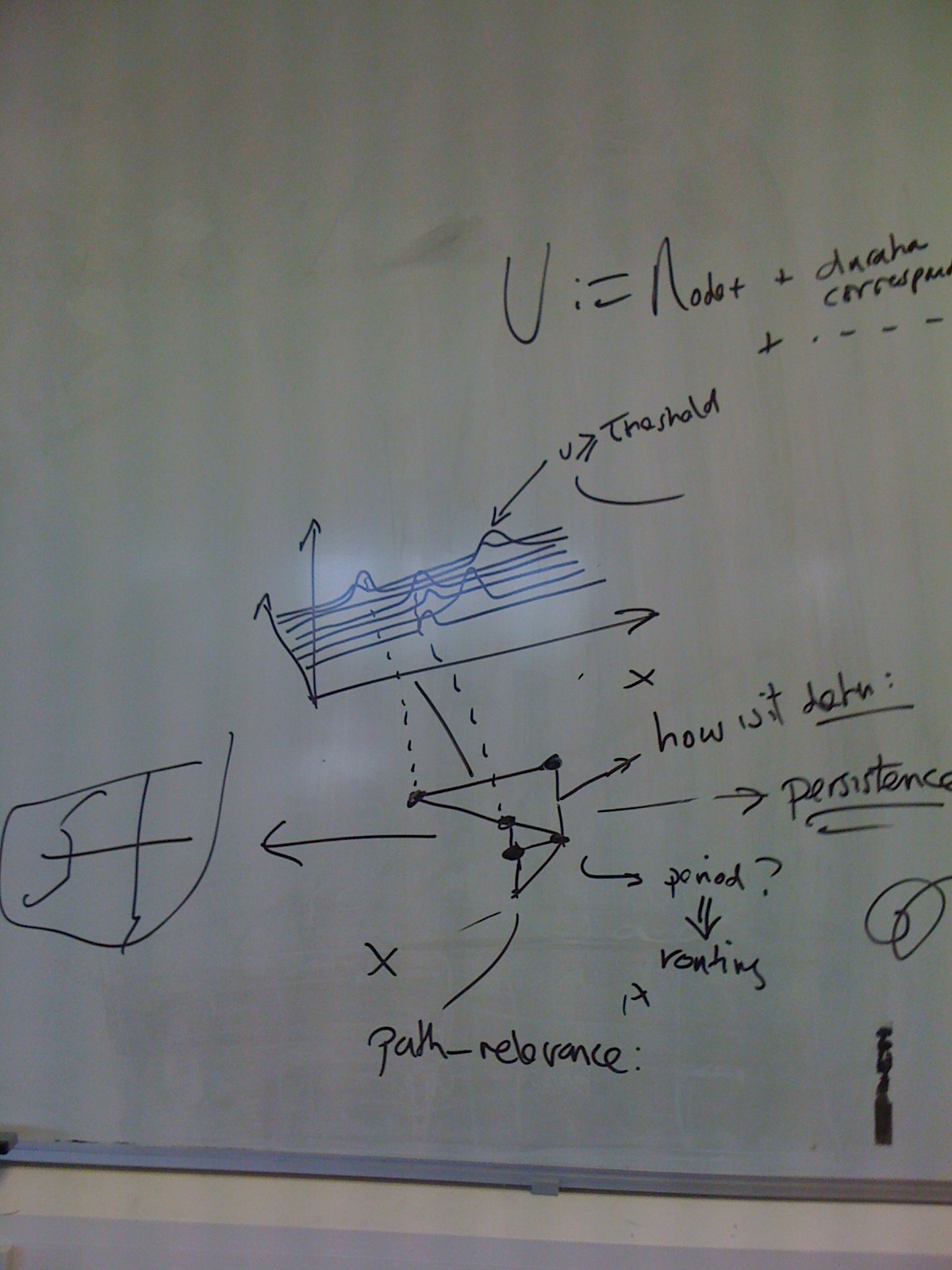
Meeting with Paddy 9 March 2010

March 9th, 2010 3 comments

Met with Paddy to discuss funding and an idea of direction in PhD

Paddy said that if his EU grants get signed off, he will garauntee me another 1 year of funding from September, the only requirements will be a chunk of work which results in a ~30 page document – something to do with autonomous software patching.

Also spoke to him about the idea of Vector clocks and how we can use them for opportunisic networking – he wondered whether we could derive some utility for locations, perhaps based on duration spent at a location, number of nodes in that location etc. etc.

He said that perhaps a good paper would be on techniques for analysing locations for use with opportunistic networking.

Paddy said that he wants me to aim to submit to CfP on Social Based Routing in Mobile and Delay Tolerent Nets the deadline is in June, and split the time up until then into 6 week chunks, and for the first chunk, tell him what I will be doing – i.e. what problems I am solving, and for the whole time, what my goals are.

Also spoke about my idea for using the Dublin Bus network for research and profit – he mentioned a guy in trinity who has access to a load of transport data and also suggested I dig out an email address of someone important at Dublin bus, and send them a formal email about gettin information about the bus, and CC him (so it looks official).

He also mentioned the TextUS service based at DCU, (runs the Aircoach SMS payment service, and the SMS parking scheme) who we could collaborate with to provide a TFL type service for dublin.

Discussion with Paddy and Davide 2nd Feb 2010

February 2nd, 2010 No comments

Met with Paddy and Davide and discussed what we have been doing.

  • Actions from last meeting:
  • Said that I had been collecting data which seems to have good location information.
  • Had spoken with prag etc. but not really very useful
  • Davide has come up with some great questions for analysis of data
  • The only thing I hadn’t done was arrange a presentation for findings so far.

Paddy was happy with the progress so far, and after we discussed a number of things, we came to the following action points:

  1. Do a quick and dirty analysis of data
    1. Mobility analysis
    2. Periodicity
    3. Buddys
    4. Spatial degree
    5. Situation detection e.g. what does periodiciy mean?
  2. This is so that we can ask:
    • Do we have the data we need already?
    • What are the limitations of the data?
    • Are there other questions we need to ask?
  3. Plan a presentation for next wednesday morning (more of a brainstorm) to develop the ideas further, and really try to hammer down the larger plan

Paddy also suggested that we think about putting a paper into ubicomp (deadline 13th March) about our analysis of this data, but put a spin on it, e.g. what does periodicity mean? Can we predict events based on this? – Can we infer some useful context, based simply on the structure of the data, without the need for advanced techniques ( – i call this Urban Guerilla Sensing).

We suggested that we might be able to do two applications based on one of buddy finding analysis part (see mobile_agents and PhD the Story) the first, Paddy dubbed F3 (Facebook Friend Finder) where we encourage people to collect data for us, in return for detecting the presence of other facebook users, and suggesting friends based on frequency of co-location. The second was a similar application, but for regular visitors to research seminars.

I mentioned my vision on the next three points of reference, the first being a paper about the collection and analysis of this dataset, the second being another work which tied this into an simulator for the dataset, which synthesises this data in to a generic set, which can be used to test MANETs etc. The final thing (I didn’t get this far) being the final writeup of my PhD which brings all of these ideas together.

Paddy likes this, and suggested the idea of Pattern Language (used to desrcribe patterns in software engineering) which had recently been applied to Ubicomp environments to describe patterns in situations, Paddy thought that this might be particularly relevent to this, and that he would like to see some language of description emerge from our analysis. This sounds like a great idea. 🙂

Finally, Paddy spoke anbo

Meeting with Paddy 7th Dec 2009

December 8th, 2009 No comments

Had a meeting with Paddy (Audio here)

Actions:

  • project/ experiment -find some location data extract and parse it,
    • Have to have a set of questions we are going to ask of the data
    • Looking for structures in the data – what are they?
  • extract soem temporal and strcutural patterns
  • Speak to prag (network clique) to find techniques on how to extract patterns from these networks.
  • Email Simon, Aaron and Adrian, to see if they know about, or have dealt with any large datasets which include accurate location information.
  • In 6 weeks present to a group of people about initial findings, and ideas for further research. but beforehand, keep in sync with Paddy, and make sure I don’t go off track. Keep a record in a wave about progress.
  • Also, investigate movement patterns.

Justifications for this:

Burst Situations – emergency situations – however movement patterns are different in this case.

Focus in on simple pragmatics – I want to be able to send free messages.

Pick social everyday applications that justify it – (parasitic networking?).

Need to focus on detailed stuff – get numbers,

Focus on movement patterns – what recurring patterns are in there – need to data mine it all.

How do we collect data, sufficiently large, and in constrained sets.

Padraig Cunningham group doing network analysis – We can use Paddy’s Social network to get help with things like statistics etc.

Extracitng movement patterns from everyday life – augemtnting with context information.

Set up experments

do blind first  – capture everything from individula, apply analysis just to movement informations plus simulation, then you take in to accoutn context information and see if it improves anything. Theres nothing to say that context is useful all the time. Perhaps we find it reduces the number of hops, this reduces failure rate.

Chapter 1 is the broad view – DTNs Human Movent – underlying model of data transmission. my hypothersis is that human moevemtn patterns will provide an underlying model for transmission of data on ad-hoc networks.

Next actions:

Think up and construct an experiment and do it – short term 3-4 week expt whewre we actually get somehting out of it – needs to be a small constrianed expriment, that takes into account movement and context.

Have to have a set of questions we are going to ask of the data:

Looking for structures in th data what are they?

couple of conversations: Prag Sharma – good talking point – i’ve got this data, I want to use thi

try to characterise the patterns – they might be structural patterns, or temporal –

Skype Meeting with Paddy 6 Dec 2009

December 7th, 2009 No comments

Had a skype meeting with paddy, and spoke about what I was going to do regards PhD (2009-12-07-time-15_24_48-Skype Call With Paddy)

  • I need to: Persuade Paddy that Natural Dynamic Networks idea don’t already exist in the literature
  • Convince him that that eperiments that I might construct are actually interesting for some reason – i.e. what is the point
  • Really nice to have 1 paragrah story line that we both agree tomorrow that we only change if the experiments tell us so, not just because something else comes along.

Need to be able to say – here’s my definition, here’s what it means, here’s what im gonna experiment on in the next 3-4 months.

Task is to come up with bullet points:

  • here’s my definition of NDN
  • hows its different from the way others people view networks?
  • If this is true, then we can do the following … A, B, C
  • if this is tru, then the experiments we can do are …

Forms the starting points of tomorrows meeting, that, we believe the first statement – that nobody has done this before.

Paddy will try to find some literature to find a few rocks to throw at me! so we can defend it.

If we can defend that – we can really question – we conjecture that we might be able to do the following.

Get arguments prepared for:

If we can do opportunistic routing – what do we get out of it, why is it better than what we have at the moment?

Supervisor Meeting 10 Nov 2009 (O’Sheas)

November 10th, 2009 No comments

Had a meeting with Paddy in O’Sheas.
The main outcome was that I need to come up with some refined research questions, in the next two and a half weeks, that really define what I will do for my PhD, they should be structured in a way that must really get to the point about what people have done so far, what we will do, and how we think this will make some difference. It must be clear what our work compares to and what metrics it can be measured agains. At the lower level, we have to show how these questions lead us to the experiments we want to perform, and how these experiments will help us prove our point. At the highest level, we need to step back and look at the big picture, and see what it is that our work contributes to .

Practically, I will start a google wave as part of the workup of these ideas, which I will share with Paddy, the protocol being that when one of us makes a change, we will email the other.

When Paddy is back, we will get together to go over what we have come up with, and then later in the week I will present a few pages of my ideas to GW, DC and others, to get their input on the direction of the research.

Paddy also said that funding wise, his plan is as follows: He will guarantee that fees will be paid when IRCSET runs out, and if I cannot get an extension, he will make sure that I can get funding from somewhere if he can. The overall plan being that I have another 14 months of funding, meaning that I should spend the next 8 months working on PhD experiments and ideas etc. Then the final 6 months writing up.

Paddy also asked if I wanted to become a part of Clarity,  in the sense that I would get access to their data, and they would be able to tick a box for extra people in Clarity seperately funded by IRCSET.  I did not make a decision, but it sounded like a good idea.

Paddy also asked if I would cover a lecture this week on P2P for Distributed Systems, and when I asked if I would get Leturers pay for it, he said he couldn’t pay me, but he would buy a small piece of technology for me.

I also asked about the possibility of getting  a new laptop, and he said that should be ok, and I spec one up that is not too expensive, but is still future proof . (IBM-Lenovo/Dell/Apple/)

As a suggestion towards good time management, Paddy suggested I make sure I am working on PhD stuff 4 days a week, and spend only 1 day working on related projects.

ODCSSS 2009

June 16th, 2009 No comments

I have taken on mentorship of an ODCSSS project which we have dubbed – CitySense. My student, John Paul Meaney, is currently working on plugging in movement models to TOSSIM and Tiny OS – and also implementing simple DTN protocols. We have chosen TinyOS and TOSSIM so that we are able to easily test this in the real world, to compare data with simulation data.

Simons Subgroup Meeting 02 Mar 2009

March 2nd, 2009 No comments

Today I met with Simon and his subgroup, to which I have become an adopted member, to get some feedback about my PhD direction.

I had previously met them and gave a 25 word overview of my PhD topic. At that time they were very helpful in giving feedback about the viability of my topic, and we suggested that at the next meeting we would talk in more detail about myself and Olga’s research.

At this meeting, I gave an overview that I was interesting in researching what the combination of social networks, and personal devices, to create a Delay Tolerant Network technique that uses the properties, facets and behaviours of human networks and mobility to send messages. With a view to using this network for metropolitan area environmental sensing.

I described my thoughts that we are reliant upon a infrastructure for our networking needs today, but there are various costs to this. To the user, to the providor, and perhaps to the environment. I gave some rough calculations as to the cost of deploying 1000 motes for a year which based their reporting communications on 3G networking, and whilst an individaul mote only used approx 240kb per day of bandwidth, this equated to 85GB per year, at a roughly estimated cost of 42,000 euros per year.

I said that I felt it is feasible to deploy some other mechanism for comunications that utilises the power in our pockets. I asked for confirmation that this was a valid topic, and that there was enough scope for research in this to make it a valid topic.

The general feeling was that there were some novelties in this, and Davide (Cellai) gave a very good explanation of similar problems in nature (Protein Interaction Networks) and felt that the science was in finding a way to describe such dynamic networks, and that there was allready a lot of research in static networks, but not in these dynamic ones.

Point 1: There is no formal language to describe dynamic networks/ the dynamics of networks

Question 1: How do you descibe how a network is evolving?

Question 2: What parameters do you need/have to describe?

Cosideration 1:  Failure models

Simon pointed out that this type of research is validated by NASA who are looking for ways to use DTN in swarm based autonomous missions to mars/space. Whilst this is not directly related (due to a lack of social networks), the ideas can still be used.

Davide also pointed out that in his and Graeme’s research, they have identified that mobility models provide a structure to, and therefore affect, dynamic networks, and that there is an area of research in this space. (which confirms my previous thoughts and efforts towards generating a reliable mobility model)

Meeting with Paddy 20 Nov 2008

November 20th, 2008 No comments

Brief meeting with paddy.

We both like the idea of the City wide sensing idea using mobile devices. I mentioned that Jo K had thought the whole routing thing had been done, but paddy suggested that there is different view on similar problems that still yield interesting research topics.

We discussed simulations, and I mentioned the idea of using some datasets from Dublin traffic, and maybe even the wireless access point data from UCD campus to simulate social networks.

Paddy mentioned an IBM city simulator that has since disappeared, but will see if he can find out more about it (I will too).

Going forward, I should have a project to get my teeth into, that has some proper research outcomes, which should be a shot term project – 3 months.

I will arrange a meeting with myself, Paddy, Aaron and Simon for sometime very soon to come up with ideas.

I should probably come up with some suggestions to work with, for what the project could be. *thinking cap on*