Archive

Archive for the ‘Ideas’ Category

Discussion with Paddy and Davide 2nd Feb 2010

February 2nd, 2010 No comments

Met with Paddy and Davide and discussed what we have been doing.

  • Actions from last meeting:
  • Said that I had been collecting data which seems to have good location information.
  • Had spoken with prag etc. but not really very useful
  • Davide has come up with some great questions for analysis of data
  • The only thing I hadn’t done was arrange a presentation for findings so far.

Paddy was happy with the progress so far, and after we discussed a number of things, we came to the following action points:

  1. Do a quick and dirty analysis of data
    1. Mobility analysis
    2. Periodicity
    3. Buddys
    4. Spatial degree
    5. Situation detection e.g. what does periodiciy mean?
  2. This is so that we can ask:
    • Do we have the data we need already?
    • What are the limitations of the data?
    • Are there other questions we need to ask?
  3. Plan a presentation for next wednesday morning (more of a brainstorm) to develop the ideas further, and really try to hammer down the larger plan

Paddy also suggested that we think about putting a paper into ubicomp (deadline 13th March) about our analysis of this data, but put a spin on it, e.g. what does periodicity mean? Can we predict events based on this? – Can we infer some useful context, based simply on the structure of the data, without the need for advanced techniques ( – i call this Urban Guerilla Sensing).

We suggested that we might be able to do two applications based on one of buddy finding analysis part (see mobile_agents and PhD the Story) the first, Paddy dubbed F3 (Facebook Friend Finder) where we encourage people to collect data for us, in return for detecting the presence of other facebook users, and suggesting friends based on frequency of co-location. The second was a similar application, but for regular visitors to research seminars.

I mentioned my vision on the next three points of reference, the first being a paper about the collection and analysis of this dataset, the second being another work which tied this into an simulator for the dataset, which synthesises this data in to a generic set, which can be used to test MANETs etc. The final thing (I didn’t get this far) being the final writeup of my PhD which brings all of these ideas together.

Paddy likes this, and suggested the idea of Pattern Language (used to desrcribe patterns in software engineering) which had recently been applied to Ubicomp environments to describe patterns in situations, Paddy thought that this might be particularly relevent to this, and that he would like to see some language of description emerge from our analysis. This sounds like a great idea. 🙂

Finally, Paddy spoke anbo

Supervisor Meeting 10 Nov 2009 (O’Sheas)

November 10th, 2009 No comments

Had a meeting with Paddy in O’Sheas.
The main outcome was that I need to come up with some refined research questions, in the next two and a half weeks, that really define what I will do for my PhD, they should be structured in a way that must really get to the point about what people have done so far, what we will do, and how we think this will make some difference. It must be clear what our work compares to and what metrics it can be measured agains. At the lower level, we have to show how these questions lead us to the experiments we want to perform, and how these experiments will help us prove our point. At the highest level, we need to step back and look at the big picture, and see what it is that our work contributes to .

Practically, I will start a google wave as part of the workup of these ideas, which I will share with Paddy, the protocol being that when one of us makes a change, we will email the other.

When Paddy is back, we will get together to go over what we have come up with, and then later in the week I will present a few pages of my ideas to GW, DC and others, to get their input on the direction of the research.

Paddy also said that funding wise, his plan is as follows: He will guarantee that fees will be paid when IRCSET runs out, and if I cannot get an extension, he will make sure that I can get funding from somewhere if he can. The overall plan being that I have another 14 months of funding, meaning that I should spend the next 8 months working on PhD experiments and ideas etc. Then the final 6 months writing up.

Paddy also asked if I wanted to become a part of Clarity,  in the sense that I would get access to their data, and they would be able to tick a box for extra people in Clarity seperately funded by IRCSET.  I did not make a decision, but it sounded like a good idea.

Paddy also asked if I would cover a lecture this week on P2P for Distributed Systems, and when I asked if I would get Leturers pay for it, he said he couldn’t pay me, but he would buy a small piece of technology for me.

I also asked about the possibility of getting  a new laptop, and he said that should be ok, and I spec one up that is not too expensive, but is still future proof . (IBM-Lenovo/Dell/Apple/)

As a suggestion towards good time management, Paddy suggested I make sure I am working on PhD stuff 4 days a week, and spend only 1 day working on related projects.

Discussion with Graham W

October 26th, 2009 No comments

Had a discussion with GW about other things to test within datasets, for example, what use is it to simulate message passing between users who do not know each other, and if we had some knowledge about this data, can we find a more efficient way to route messages. This led us to talk about:

  • how many nodes can you get to within x hops in a network?
    • how many paths between friends need to use strangers and vice versa – can be used rto define privacy rules too 🙂
    • see miklas paper about defining friends and strangers
    • The point being that you may never need to send a message to any body else

Graham showed me how to run the simulator he wrote, and we talked about writing a paper together for an upcoming conference – but decided the deadline was too soon, and that we didn’t have any new results to put into it.

Mini-Project discussion with Davide

April 9th, 2009 No comments

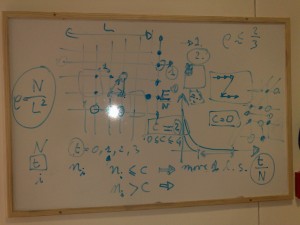
Met with Davide at the whiteboard on the 3rd floor lobby to discuss and mini-project for me to do.

Meeting with Davide 09th Apr 2009

In the context of mobile sensor nodes, he would like to discover if we can reduce the overall total of Neighbors nodes (i.e. the sum over all nodes, of the number of neigbors each node has)

E = SUM(0 to n: total neigbors)

Construct a lattice of size L2 with N nodes, Each node may only move along the lines of the lattice, each costing 1.

Time is discreet, at intervals 1,2,3 … n etc. and

at each time step,

a node at random is picked,

if the node has less than or equal to C neighbors, then it picks one of the four surrounding points, and if that point is empty, it moves to that point, else it stays where it is.

else if the node has a value greater than C neighbours, it will pick a a diagonal position (2 hops) at random, and if it is not occupied, it will move, else it will stay where it is.

(Nodes will not bounce off the side of the lattice, but will continue to the other side.)

We will measure the value of E over T (time), and also the cost of movements.

T is not the timesteps, but each discreet value of T is the next step when each node has on average had the chance to move once (i.e. T is when t equals the number of nodes)

The overall effect should be to reduce density, speedily, as when there are too many neighbors, movement is ‘faster’ i.e. more hops.

The idea is to simulate this to generate some nice graphs

Categories: discussions, Ideas, projects

Simons Subgroup Meeting 02 Mar 2009

March 2nd, 2009 No comments

Today I met with Simon and his subgroup, to which I have become an adopted member, to get some feedback about my PhD direction.

I had previously met them and gave a 25 word overview of my PhD topic. At that time they were very helpful in giving feedback about the viability of my topic, and we suggested that at the next meeting we would talk in more detail about myself and Olga’s research.

At this meeting, I gave an overview that I was interesting in researching what the combination of social networks, and personal devices, to create a Delay Tolerant Network technique that uses the properties, facets and behaviours of human networks and mobility to send messages. With a view to using this network for metropolitan area environmental sensing.

I described my thoughts that we are reliant upon a infrastructure for our networking needs today, but there are various costs to this. To the user, to the providor, and perhaps to the environment. I gave some rough calculations as to the cost of deploying 1000 motes for a year which based their reporting communications on 3G networking, and whilst an individaul mote only used approx 240kb per day of bandwidth, this equated to 85GB per year, at a roughly estimated cost of 42,000 euros per year.

I said that I felt it is feasible to deploy some other mechanism for comunications that utilises the power in our pockets. I asked for confirmation that this was a valid topic, and that there was enough scope for research in this to make it a valid topic.

The general feeling was that there were some novelties in this, and Davide (Cellai) gave a very good explanation of similar problems in nature (Protein Interaction Networks) and felt that the science was in finding a way to describe such dynamic networks, and that there was allready a lot of research in static networks, but not in these dynamic ones.

Point 1: There is no formal language to describe dynamic networks/ the dynamics of networks

Question 1: How do you descibe how a network is evolving?

Question 2: What parameters do you need/have to describe?

Cosideration 1:  Failure models

Simon pointed out that this type of research is validated by NASA who are looking for ways to use DTN in swarm based autonomous missions to mars/space. Whilst this is not directly related (due to a lack of social networks), the ideas can still be used.

Davide also pointed out that in his and Graeme’s research, they have identified that mobility models provide a structure to, and therefore affect, dynamic networks, and that there is an area of research in this space. (which confirms my previous thoughts and efforts towards generating a reliable mobility model)

Meeting with Fred Clarke and John Curran 26th November 2008

November 26th, 2008 No comments

Met with John Curran and Fred Clarke regarding using logs from the wireless access points

The data available for WaveLAN is building level DHCP leases, but not AP level information, this is available to us, as it is pretty much anonymous.

The data available from the Eduroam system is more detailed an includes authentication information, access point details etc. we would need to discuss how we would anonymise this data before we could use it.

Neil O’Reilly would be able to give use a sample of the logs for the wavelan network, so we could see what information is available,

We need to send a doc to give the following:

who has access
how long we will keep it
how we would dispose of the data
e.g. assume this is personal data, how will we deal with it?

Meeting with Paddy 20 Nov 2008

November 20th, 2008 No comments

Brief meeting with paddy.

We both like the idea of the City wide sensing idea using mobile devices. I mentioned that Jo K had thought the whole routing thing had been done, but paddy suggested that there is different view on similar problems that still yield interesting research topics.

We discussed simulations, and I mentioned the idea of using some datasets from Dublin traffic, and maybe even the wireless access point data from UCD campus to simulate social networks.

Paddy mentioned an IBM city simulator that has since disappeared, but will see if he can find out more about it (I will too).

Going forward, I should have a project to get my teeth into, that has some proper research outcomes, which should be a shot term project – 3 months.

I will arrange a meeting with myself, Paddy, Aaron and Simon for sometime very soon to come up with ideas.

I should probably come up with some suggestions to work with, for what the project could be. *thinking cap on*

PhD Direction Meeting 13 Nov 2008

November 13th, 2008 No comments

Met with Simon and Aaron this morning to talk about the direction of my PhD 🙂

I introduced the city sensing idea that Paddy and I had talked about – and that I had previously sent to Simon to comment on.

I also started by saying that I am interested in the problem of Delay Tolerant Networks.

Firstly, we tried to sketch out the problem to be solved – I could not really describe it, so Aaron suggested that one of the problems is that of infrastructure – i.e. it is very expensive to install and use. For example, is every phone in Dublin was reporting sensor data, it would firstly swamp the network, and secondly be prohibitively expensive.

Simon also suggested that it was a problem of coverage – in areas where there is no infrastructure, how to do you report sensor data?

Aaron and Simon stressed that it was important to relate this problem to the real world by giving real examples – such as figures for infrastructure cost – data usage and network utilisation. But if we cannot get figures for this, we can make estimates based on what we do know.

Aaron mentioned an experiment he did when in Australia with ?(Dan)? which tested bluetooth hand-off times – and found that the handshake time was very long – and too long for passing nodes to exchange data. Simon and Aaron therefore suggested that a low level protocol could be designed, that if we assume it existed – could form the basis from which my contribution works.

This would mean that any system based on this, would have to be simulated, as the protocol itself would not be implemented for real (not by me anyway). Ideally however, I would have a system running on every phone in Dublin from now until when I analyse the data, however, this is not going to happen. But having it run on 10 phones would be nice, on 100 would be difficult but better, on 1000 phones, very very hard but very nice.

However, at this point, my contribution is unclear – so we discussed some ideas:

  • Micro messaging of data, small packets sent until out of range, making it as efficient as possible, some data wont get sent, but some will.
  • Reporting that things are normal, but not sending the data, as it can be derived that if there is nothing abnormal, then we wont send data we just ACK that everything is ok. – I suggested that this may be similar to Erasure coding which xors messages against previous known messages to extract the new message.
  • Perhaps we could utilise a mechanism for piggy-backing data over existing protocols – such as Bluetooth Friendly names, or spoofed MAC addresses, or on ARP requests.

We discussed simulations, and Aaron noted that Brendan has cluster access for processing large amounts of data – and also mentioned OmNet for running simulations.

Aaron mentioned that when they wrote their own simulation, it was deemed a bad idea, because there is no way to evaluate it, so suggested that we should not write out own simulator for anything.

I mentioned that a paper I had read had used information from wireless access points use (CRAWDAD) to simulate a network of people, and mentioned that I had contacted IT services at UCD to see what data they keep about access point use, and whether we can use it. Aaron suggested that I email him and Simon with my request and they will see if they get access to the data.

Simon mentioned Bill Hilliers book – space is the machine – which is worth dipping into when considering how to simulate city environments.

Aaron said that his student ?Dan? had taken a real un-related dataset, and synthesised a relevant data set from it (iSpy search dataset).

Another dataset that is apparently available is live data from traffic lights in Dublin, which shows the position of the lights, the number of cars queueing and is available live onlin.  – I wil email Kevin McCarthy who may know who has information about this.

I suggested that we could get traces of data from second life, which may give a good dataset for simulating the movement of people around a geographic area. This has inherent problems, but might be interesting.

I Suggested that there was (based on a survey paper by Zhensheng Zhang 2006 [1]) a research area for profiling nodes in a network to predict their future movements, which prompted:

Simon gave an example of a system used at Reading university where they tracked people in a building using RFID tags, and found that people generally had very predictable routines.

Simon also mentioned a paper by Sandy Pentland about familiar strangers – the people you come into contact with regularly, that you don’t necessarily know – these people could be used (discretely) to send messages to people they may come into contact with.

Aaron introduced a Clarity Project called Sense in the City, or more specifically GOYA which he thinks I may be able to become involved with, and he suggested that I email Paddy and Barry to say that I would like the slides from the CLARITY away day, and that I would like to find out more information about the project it becomes a reality – but that I shouldn’t spend too much time on finding out about it at the moment.

The project envisages using a network of bicycles which are installed with sensors, that people use to get around the city. He suggested that it is a good idea to have a case study – such as this – which tests my system in the real world with interesting results.

He also mentioned the idea of Healthy Spaces – urban parks where people walk around – may not be obvious on the map – but in return for generating interesting sensor data, we can map out where these places are – and perhaps contribute to the health credits idea (discount on Health insurance).

We identified some next actions:

  • Matt: Document: define the problem, define the motivation
  • Matt: Email paddy + Barry for slides
  • Matt: Email Simon + Aaron about wireless access points log access
  • Matt: Email Kevin about traffic information
My RSS Talk next week (18 Nov 2008)

November 12th, 2008 No comments

My RSS talk is on Tuesday – as i’m struggling to get my head around a thesis topic – I have decided to do my talk on Delay Tolerant Networks (DTN) and intend to use the first paper I can find on it (which has been cited as the seminal paper on it – Li and Rus – Sending Messages to mobile users in disconnected ad-hoc networks – MobiCom ’00: Proceedings of the 6th annual international conference on Mobile computing and networking), the first paper on Epidemic routing (Amin Vahdat and David Becker, Epidemic routing for partially-connected ad hoc networks – Tech Report – 2000), and the most recent paper by Cecilia Mascolo -(CAR: Context-aware Adaptive Routing for Delay Tolerant Mobile Networks – IEEE Transactions on Mobile Computing 2008)

I think this fits in with the idea we had a while ago – but we still need to talk about the whole thing – from my recent reading there is a lot of interesting stuff on DTN and it seems to be a relatively new field.

A survey paper of the area I read recently suggested a few areas of research, one of which I am particularly interested in – how to create context profiles for users in a system to improve routing accuracy – specifically – profile a users movement habits – routes, places and regular encounters.

City wide environment sensing overview

October 15th, 2008 No comments

city-wide-environmental-sensing-overview

The document I drew up after supervisor meeting – to get a general overview of the idea.