Archive

Archive for the ‘discussions’ Category

Presentation 10th Feb 2010

February 11th, 2010 No comments

Gave presentation to Paddy, Davide, Neil Cowzer and Fergal Reid (clique) about my quick and dirty analysis of the dataset that I have collected allready.

Slides

General concensus was that there was not really enough users, and so there were some suggestions about other datasets that might be found -persuade a mobile phone company to give data about user movements. Mine flickr/twitter for geo-tagged photo’s/tweets, and try to determine groups of people based on similar locations.

Also suggested that the GMA is good for visualising data, not greatly interesting, PH is interesting as is SPD. BD is something that is useful as an application to gather data, but would need a very large engineering effort.

Paddy suggested that if we could make the data collection process very easy, then we could throw it out to the student population to start collecting data. Fergal said that in J2ME it would be very difficult, but by sticking to C++ it might work (for Nokia phones).

Also talked about getting ground truth for data, Fergal Suggested collecting accellorometer data too (so if someone asked – how did you verify GPS trace, one can say that we correlated it with the accelorometer data). I also suggested tagging locations.

Determined the following actions:

  • Look for access to datasets with good location – 1 week
    • WaveLAN Dataset
    • HeaNET – chase paddy – Eduroam
    • Mine location data from Flickr
  • Look at applying analysis to these datasets – specifically
    • Periodicity Hunting
    • Spatial Dependance on the Degree
  • See if we can construct overlay over these networks
    • e.g. drop nodes
      • Popular locations
      • popular people
      • Other?
      • Vector clocks might be the way to do it
  • Read up about Vector Clocks as suggested in the paper by Klineberg, Watts and ???? at  KDDOA
  • Speak to Graham about whether I can easily integrate this data into his code, if so – do it, otherwise think about implementing it seperately(robustly!)

Also planned to meet Paddy again next week to go over these things, and try to hammer out a better plan. Then meet with these people again in three weeks to show where I have go to.

Davide also talked about churn in proximity patterns – might be worth thinking about what this means (example was then a person regularly sees other people, and after a while, one of those people drops off the radar – what does this mean)

Paddy said that in his mind, the long goal is to be able to forward plan using the knowledge of data that has passed (prediction).
Discussion with Davide about plots etc 4th Feb 2010

February 4th, 2010 No comments

Three types of data analysis:

General Mobility Analysis

We calculate the distance between locations at the start of every time period, (e.g. 1 hour) and plot the number of time that particular distance is travelled (to some granularity) over some time period (1 week maybe)

Periodicity Hunting

We measure the time spent at a location, and count the number of times in a bounded time period (say a week), using the same timescale as above to bracket readings.

(people visit common locations frequenly, or the visit some locations for a long period of time. – also think about the case that lots of people visit a common location infrequently/frequently).

Statial Dependance of the Degree

We count the number of devices seen in a given time period (same as above – e.g. 1 hour) and the location

Buddy Discovery

We count the duration of the contacts between pairs (the user and the devices he can see) and also the location of the contacts, and try to see which devices are seen most often, and then try to see which devices are seen at multiple locations. (using the same time period as above – 1 hour slots over a week)

Categories: discussions, Ideas, projects

Discussion with Paddy and Davide 2nd Feb 2010

February 2nd, 2010 No comments

Met with Paddy and Davide and discussed what we have been doing.

  • Actions from last meeting:
  • Said that I had been collecting data which seems to have good location information.
  • Had spoken with prag etc. but not really very useful
  • Davide has come up with some great questions for analysis of data
  • The only thing I hadn’t done was arrange a presentation for findings so far.

Paddy was happy with the progress so far, and after we discussed a number of things, we came to the following action points:

  1. Do a quick and dirty analysis of data
    1. Mobility analysis
    2. Periodicity
    3. Buddys
    4. Spatial degree
    5. Situation detection e.g. what does periodiciy mean?
  2. This is so that we can ask:
    • Do we have the data we need already?
    • What are the limitations of the data?
    • Are there other questions we need to ask?
  3. Plan a presentation for next wednesday morning (more of a brainstorm) to develop the ideas further, and really try to hammer down the larger plan

Paddy also suggested that we think about putting a paper into ubicomp (deadline 13th March) about our analysis of this data, but put a spin on it, e.g. what does periodicity mean? Can we predict events based on this? – Can we infer some useful context, based simply on the structure of the data, without the need for advanced techniques ( – i call this Urban Guerilla Sensing).

We suggested that we might be able to do two applications based on one of buddy finding analysis part (see mobile_agents and PhD the Story) the first, Paddy dubbed F3 (Facebook Friend Finder) where we encourage people to collect data for us, in return for detecting the presence of other facebook users, and suggesting friends based on frequency of co-location. The second was a similar application, but for regular visitors to research seminars.

I mentioned my vision on the next three points of reference, the first being a paper about the collection and analysis of this dataset, the second being another work which tied this into an simulator for the dataset, which synthesises this data in to a generic set, which can be used to test MANETs etc. The final thing (I didn’t get this far) being the final writeup of my PhD which brings all of these ideas together.

Paddy likes this, and suggested the idea of Pattern Language (used to desrcribe patterns in software engineering) which had recently been applied to Ubicomp environments to describe patterns in situations, Paddy thought that this might be particularly relevent to this, and that he would like to see some language of description emerge from our analysis. This sounds like a great idea. 🙂

Finally, Paddy spoke anbo

Meeting with Prag 9 Dec 2009

December 10th, 2009 No comments

Had a brief meeting with Prag Sharma, who described to me the sort of things that the clique group were doing.

I explained to him that I was interested in ways of analysing social networks in terms of movement patterns. He mentioned a few datasets that clique has some access to: Conrad and Fergul have access handset data from 6 million Nodes from a telephone network – IDIRO, but he did not know what the data included. Another dataset was NORON data, which is to do with financial fraud and included banking transaction data.

He suggested that a good person to talk to was Derek Green, who he thought was doing  similar work.

We saw Derek in is cube, and it seems he is looking more at social clustering, but we thought there might be some interesting overlap, so I will send him my position paper, and he will send me his recent presentation.

Prag suggested I check out the clique website.

Supervisor Meeting 10 Nov 2009 (O’Sheas)

November 10th, 2009 No comments

Had a meeting with Paddy in O’Sheas.
The main outcome was that I need to come up with some refined research questions, in the next two and a half weeks, that really define what I will do for my PhD, they should be structured in a way that must really get to the point about what people have done so far, what we will do, and how we think this will make some difference. It must be clear what our work compares to and what metrics it can be measured agains. At the lower level, we have to show how these questions lead us to the experiments we want to perform, and how these experiments will help us prove our point. At the highest level, we need to step back and look at the big picture, and see what it is that our work contributes to .

Practically, I will start a google wave as part of the workup of these ideas, which I will share with Paddy, the protocol being that when one of us makes a change, we will email the other.

When Paddy is back, we will get together to go over what we have come up with, and then later in the week I will present a few pages of my ideas to GW, DC and others, to get their input on the direction of the research.

Paddy also said that funding wise, his plan is as follows: He will guarantee that fees will be paid when IRCSET runs out, and if I cannot get an extension, he will make sure that I can get funding from somewhere if he can. The overall plan being that I have another 14 months of funding, meaning that I should spend the next 8 months working on PhD experiments and ideas etc. Then the final 6 months writing up.

Paddy also asked if I wanted to become a part of Clarity,  in the sense that I would get access to their data, and they would be able to tick a box for extra people in Clarity seperately funded by IRCSET.  I did not make a decision, but it sounded like a good idea.

Paddy also asked if I would cover a lecture this week on P2P for Distributed Systems, and when I asked if I would get Leturers pay for it, he said he couldn’t pay me, but he would buy a small piece of technology for me.

I also asked about the possibility of getting  a new laptop, and he said that should be ok, and I spec one up that is not too expensive, but is still future proof . (IBM-Lenovo/Dell/Apple/)

As a suggestion towards good time management, Paddy suggested I make sure I am working on PhD stuff 4 days a week, and spend only 1 day working on related projects.

Discussion with Graham W

October 26th, 2009 No comments

Had a discussion with GW about other things to test within datasets, for example, what use is it to simulate message passing between users who do not know each other, and if we had some knowledge about this data, can we find a more efficient way to route messages. This led us to talk about:

  • how many nodes can you get to within x hops in a network?
    • how many paths between friends need to use strangers and vice versa – can be used rto define privacy rules too 🙂
    • see miklas paper about defining friends and strangers
    • The point being that you may never need to send a message to any body else

Graham showed me how to run the simulator he wrote, and we talked about writing a paper together for an upcoming conference – but decided the deadline was too soon, and that we didn’t have any new results to put into it.

Meeting – Basadaeir paper for IJHCR

September 7th, 2009 No comments

Met with Graeme, Paddy and Simon regarding a request for a submission to the IJHCR journal – from the pervasive LBR – Basadaeir paper

http://www.igi-global.com/ijhcr

We decided that even though its not directly related my research, it would be worth submitting, as we would all benefit from a journal publication, and this seems to be fairly low bar….

My job is to manage this project, and let paddy/simon/graeme know what they need to do – Paddy said he might even write something.

Graeme and I went through the basic structure of the project, and came up with some initial ideas.

The project will have to be re-worked quite substantially, and might need to be coded from scratch. I have some concerns about whether this is worth doing if it’s not going to be part of my research. Will discuss with Paddy tomorrow.

ODCSSS Meeting 18 June AM

June 18th, 2009 No comments

JP MS

We talked about where we are going with the project,I suggested 5 actions:

JP:

  • Write a project overview about his view on the project, print it out and keep it handy.
  • Write a pseudocode algorithm about how to implement routing protocol
  • Evaluate network simulators – NS2 & NS3

MS:

  • Send papers to JP – Spray and Wait, Bubble RAP, Traffic Gossip
  • Arrange Meeting with Olga/Neil

Both

  • Arrange meeting with paddy

JP wants to work with the actual implementation, rather than just simulation, which is what I would choose too.

ODCSSS 2009

June 16th, 2009 No comments

I have taken on mentorship of an ODCSSS project which we have dubbed – CitySense. My student, John Paul Meaney, is currently working on plugging in movement models to TOSSIM and Tiny OS – and also implementing simple DTN protocols. We have chosen TinyOS and TOSSIM so that we are able to easily test this in the real world, to compare data with simulation data.

Mini-Project discussion with Davide

April 9th, 2009 No comments

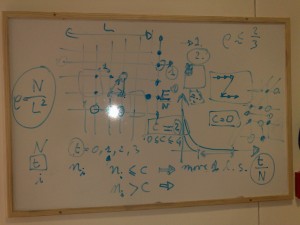
Met with Davide at the whiteboard on the 3rd floor lobby to discuss and mini-project for me to do.

Meeting with Davide 09th Apr 2009

In the context of mobile sensor nodes, he would like to discover if we can reduce the overall total of Neighbors nodes (i.e. the sum over all nodes, of the number of neigbors each node has)

E = SUM(0 to n: total neigbors)

Construct a lattice of size L2 with N nodes, Each node may only move along the lines of the lattice, each costing 1.

Time is discreet, at intervals 1,2,3 … n etc. and

at each time step,

a node at random is picked,

if the node has less than or equal to C neighbors, then it picks one of the four surrounding points, and if that point is empty, it moves to that point, else it stays where it is.

else if the node has a value greater than C neighbours, it will pick a a diagonal position (2 hops) at random, and if it is not occupied, it will move, else it will stay where it is.

(Nodes will not bounce off the side of the lattice, but will continue to the other side.)

We will measure the value of E over T (time), and also the cost of movements.

T is not the timesteps, but each discreet value of T is the next step when each node has on average had the chance to move once (i.e. T is when t equals the number of nodes)

The overall effect should be to reduce density, speedily, as when there are too many neighbors, movement is ‘faster’ i.e. more hops.

The idea is to simulate this to generate some nice graphs

Categories: discussions, Ideas, projects